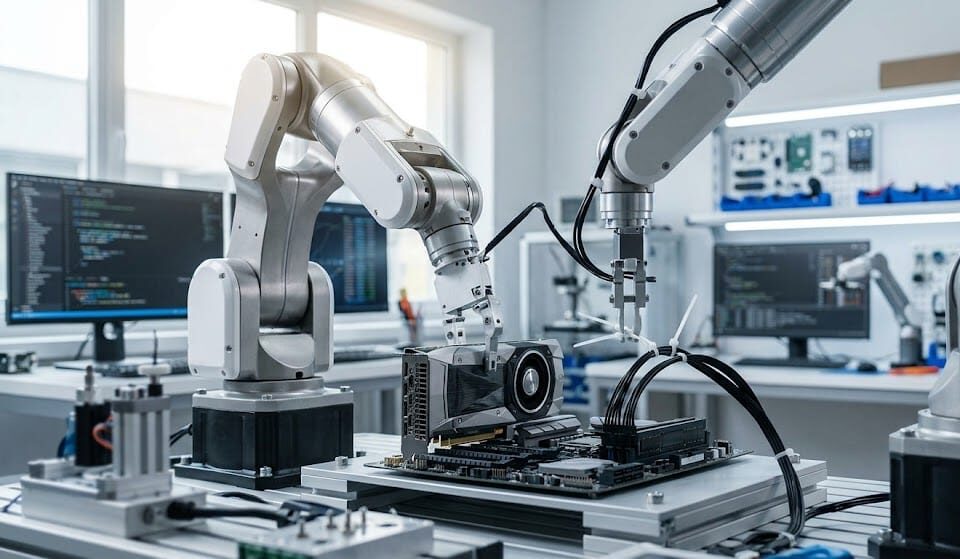
Researchers at the NVIDIA GEAR (Generalist Embodied Agent Research) lab—in collaboration with Carnegie Mellon University and UC Berkeley—have unveiled ENPIRE, an innovative automation harness framework. This software allows AI agents to independently orchestrate and supervise robot training loops without needing constant human intervention.
How the ENPIRE System Works
Operating as an advanced wrapper around Large Language Models (LLMs), ENPIRE equips AI agents with a suite of developer tools, memory, context tracking, and feedback loops to autonomously handle four critical operational stages:
- Automatic Reset & Verification: Restoring the physical testing environment to its starting state after each attempt to prepare for subsequent trials.
- Policy Tinh-Chỉnh (Refinement): Optimizing the algorithmic strategies that dictate the robots’ physical behaviors based on real-world trial data.
- Parallel Evaluation: Deploying and benchmarking training policies across multiple physical robotic arms simultaneously to accelerate validation.
- Autonomous Debugging: Parsing system logs, digesting academic research papers, and modifying code to fix infrastructure errors or refine training algorithms.
The research team evaluated ENPIRE using today’s leading frontier models, including OpenAI’s GPT-5.5, Anthropic’s Claude Code (powered by Opus 4.7), and Moonshot AI’s Kimi K2.6.
Impressive Milestones and Real-World Constraints
“A part of our NVIDIA GEAR lab now self-improves tirelessly overnight. We just read the reports in the morning.” — Jim Fan, Director of AI at NVIDIA, shared in a LinkedIn post.
- 99% Success Rate: The AI-trained robots successfully mastered highly intricate manipulation tasks. These included organizing pins in a box, tying and cutting plastic zip ties, executing the standard “Push-T” block-positioning test, and—most notably—inserting and removing a GPU into narrow motherboard slots.
- The Power of Collaboration: The experiments demonstrated clear scaling benefits. A team of 8 AI coding agents working together achieved a 99% success rate on the Push-T task in just 2 hours, outperforming a 4-agent team (3 hours) and a single agent (nearly 5 hours). In certain tasks, the multi-agent AI framework even outpaced top-tier human-in-the-loop training methods.
- Current Limitations: Despite high performance, the system hits a bottleneck where physical robots frequently sit idle. This downtime occurs while the AI agents are busy analyzing data, rewriting code, or waiting for LLM responses. Furthermore, scaling up the number of agents drastically increases token consumption and requires significant time for agents to summarize each other’s ideas.
Driving the Evolution of “Physical AI”
This breakthrough aligns with NVIDIA’s broader, aggressive push into embodied and physical AI through key industry partnerships. In late May 2026, the company partnered with Chinese robotics firm Unitree to provide a “Reference Humanoid Robot” tailored for general-purpose AI research. Shortly after in June, CEO Jensen Huang met with the Executive Chair of Hyundai Motor Group (which owns Boston Dynamics) to discuss scaling up the mass manufacturing of AI-driven robotics.