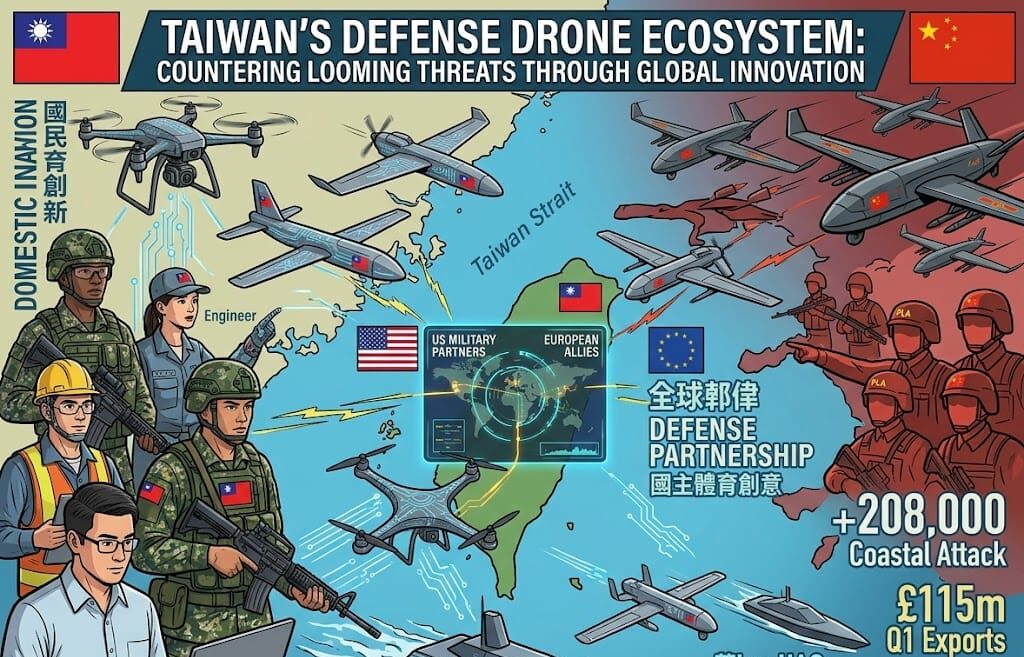
In an effort to safeguard its sovereignty against a potential invasion by China, Taiwan is rapidly expanding its military drone manufacturing capabilities. This domestic push is not only reshaping the island’s defense strategy but also paving the way for lucrative international partnerships, particularly with the United States military.
A Massive Boost in Defense Spending
Taiwan’s Ministry of National Defense recently unveiled a substantial $6.6 billion budget proposal spanning six years (2026–2031). If approved, this funding will dramatically overhaul the island’s current arsenal of roughly 5,000 drones by purchasing:
- Over 208,000 coastal attack drones
- More than 1,400 coastal reconnaissance uncrewed aerial vehicles (UAVs)
- 1,320 uncrewed surface vessels (sea drones)
This strategic pivot was highlighted during recent military drills, where Taiwanese forces successfully deployed U.S.-made Altius-600 loitering munitions and indigenous drones to neutralize offshore targets.
Capitalizing on the Global Market
The government’s financial backing is a major boon for local manufacturers like Thunder Tiger. By positioning themselves as secure alternatives to Chinese-made electronics, Taiwanese firms are seeing a massive surge in exports. In the first quarter of 2026 alone, Taiwan exported $115 million worth of assembled drones—surpassing the $93 million total recorded for the entirety of 2025.
Key market milestones include:
- U.S. Military Certification: Thunder Tiger’s “Overkill” first-person view (FPV) drones became the first from an Asian company to make the Pentagon’s Blue UAS Cleared List. These tactical drones are priced between $3,000 and $5,000.
- Heavy Munitions: The company is also producing $30,000 kamikaze drones based on the U.S. LUCAS platform, while Taiwan’s state-owned National Chung-Shan Institute of Science and Technology (NCSIST) has engineered a one-way attack drone modeled after Israel’s Harpy.
- Global Supply Chains: Taiwanese microelectronics, batteries, and flight controllers are flowing heavily into Europe (including Czechia and Poland), with many components ultimately supporting Ukraine’s defense. Thunder Tiger has even opened an Ohio-based facility capable of manufacturing 60,000 drone motors annually.
Merging Hardware with Western Software
While Taiwan excels at hardware and electronics manufacturing, local developers are collaborating with Western tech firms to integrate advanced artificial intelligence and software. NCSIST and Thunder Tiger have partnered with American and European software giants like Anduril, Auterion, Shield AI, and AeroVironment to create unified controller platforms capable of managing diverse uncrewed systems.
Navigating Headwinds
Despite the momentum, Taiwan’s drone ambitions face significant hurdles:
- Political Friction: The multi-billion-dollar drone budget faces intense scrutiny in Taiwan’s Legislature, where an opposition majority previously blocked and downsized domestic defense funding.
- The Shadow of DJI: Competing against China’s DJI—which commands a massive 70% to 80% share of the global commercial drone market—remains difficult due to China’s aggressive pricing.
- Supply Chain Cleansing: Eliminating Chinese components is a work in progress. Local manufacturers have had to defend utilizing Western-designed chips that were packaged inside China.
Currently producing 15,000 units per month, Taiwan’s Ministry of Economic Affairs aims to scale production to over 100,000 drones monthly by 2030. Drawing inspiration from Ukraine’s massive scaling of FPV drone production, Taiwan is also training civil defense volunteers in drone piloting, recognizing that human operators remain vital to modern uncrewed warfare.