Artificial intelligence has significantly accelerated the speed at which software vulnerabilities are discovered. However, simply finding bugs does not inherently secure a system; in fact, it often overwhelms open-source maintainers who are flooded with more security reports than their limited time and resources can handle.
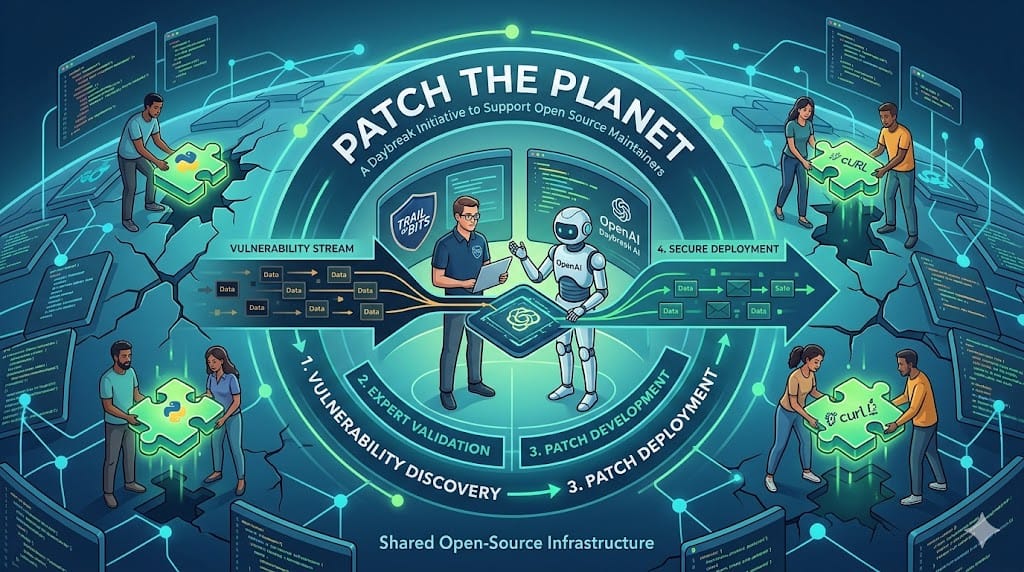
To address this defensive bottleneck, OpenAI—in collaboration with Trail of Bits—has introduced Patch the Planet, an extension of its broader Daybreak safety initiative. The program shifts the focus from mere bug discovery to an end-to-end defensive cycle: validating flaws, writing patches, and deploying fixes alongside human experts.
How the Program Operates
The initiative is built to alleviate the burden on developers rather than add to it. Every engagement is tailored to the specific needs of the open-source project:
- Human-in-the-Loop Validation: Dedicated security engineers manually review and reproduce every AI-generated finding before it ever reaches a maintainer. This drastically reduces false positives and prevents backlog exhaustion.
- Developer Empowerment: Maintainers retain absolute control over which patches are deployed and how coordinated vulnerability disclosures are handled.
- Resource Allocation: Selected projects receive access to ChatGPT Pro, conditional access to Codex Security, and API credits to automate future release workflows and maintainer tasks.
Initial Foundational Partners
The initiative has launched with a cohort of widely utilized networking, language, and cryptographic infrastructure projects, including:
- Languages & Infrastructure: Python, Go, and python.org.
- Networking & Supply Chain: cURL, NATS Server, aiohttp, and Sigstore.
- Cryptography & Web Servers: pyca/cryptography and freenginx.
Additionally, security firms HackerOne and Calif have joined the effort to assist with vulnerability triage, deeper discovery, and coordinated disclosures.
Technical Breakthroughs & Early Milestones
During the initial sprint, Trail of Bits engineers utilized GPT-5.5-Cyber and Codex Security to compress tasks that usually take weeks or months into just a few days:
- Rapid Fuzzing Labs: In less than 24 hours, the team established a comprehensive fuzzing lab covering dozens of entry points. Guided by feedback loops, GPT-5.5-Cyber independently made high-signal choices on which targets to probe.
- Automated Variant Analysis: The team built a reusable pipeline that ingests historical CVE data, extracts underlying vulnerability patterns, and automatically scans target codebases for similar latent flaws.
- Accelerated Differential Testing: Codex successfully generated the complex “glue code” required to cross-test multiple implementations of the same protocol against one another, uncovering hidden behavioral discrepancies within days.
Real-World Vulnerabilities Uncovered and Fixed
The advanced capabilities of GPT-5.5-Cyber and Codex Security have already successfully identified and mitigated critical flaws across multiple layers of the global software stack:
1. Operating Systems
- Linux Kernel: GPT-5.5-Cyber scanned more than 30 million lines of code, identifying hundreds of anomalies and autonomously generating 24 local privilege escalation exploits alongside 8 pointer leak proof-of-concepts (PoCs).
- OpenBSD: The models successfully unearthed a 23-year-old “use-after-free” bug within the kernel’s System V semaphore implementation, which could allow an unprivileged user to gain root access.
- FreeBSD: Working alongside Calif, Codex confirmed 34 vulnerabilities and successfully built 7 local privilege escalation PoCs.
2. Network Infrastructure
- dnsmasq: Codex Security independently flagged the exact vulnerable code patterns responsible for four major recent CVEs (including CVE-2026-4890 and CVE-2026-5172).
- HTTP/2 Bomb: An analysis powered by Codex exposed a widespread denial-of-service vulnerability affecting major web servers like NGINX, Apache, and IIS, potentially threatening over 880,000 active websites.
3. Web Browsers
- Chrome & Safari: OpenAI researchers leveraged the tools to discover and report 5 exploitable flaws in Chrome’s V8 engine and over 10 critical vulnerabilities within Safari’s WebKit architecture.
- Firefox: During routine safety evaluations, GPT-5.5 caught a severe WebAssembly vulnerability (CVE-2026-8390). It was patched by Mozilla just two days prior to the Pwn2Own Berlin competition, causing five out of six registered entrants to withdraw their Firefox exploits.