The landscape of Artificial Intelligence (AI) is evolving at an unprecedented pace, shifting from narrow, task-specific applications to adaptive, multi-modal, and highly autonomous systems. This summary explores the key technological pillars and innovations driving the current AI revolution.
1. Key Technological Pillars
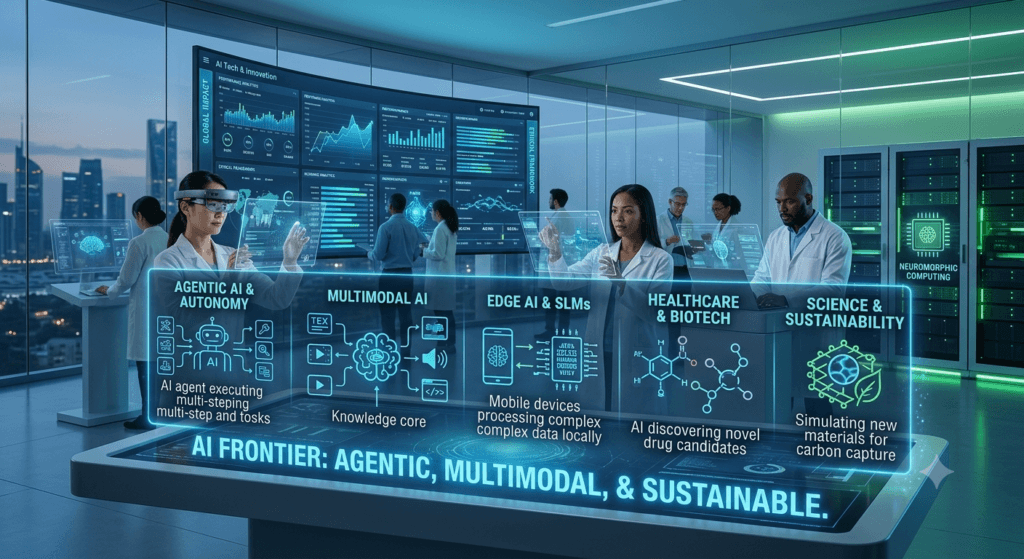
- Multimodal AI: Modern AI models are no longer limited to just text or images. Today’s architectures seamlessly process and cross-reference video, audio, code, and sensory data simultaneously, enabling deeper contextual understanding.
- Agentic AI & Autonomy: The industry is shifting from passive chatbots to “AI Agents.” These systems can reason, break down complex goals into sequential steps, use external tools (like web browsers or software APIs), and self-correct without human intervention.
- Edge AI & Small Language Models (SLMs): While massive data centers still power frontier models, massive innovation is happening in efficiency. SLMs are being optimized to run locally on smartphones and laptops, prioritizing data privacy and lowering latency.
2. Core Areas of Innovation
Healthcare & Biotechnology
AI has revolutionized molecular biology through advanced protein-folding predictions, compressing decades of laboratory work into minutes. AI-driven generative design is now discovering novel drug candidates and identifying target enzymes for diseases that were previously thought “undruggable.”
Automation & Software Engineering
Code generation has evolved from simple autocomplete to autonomous software agents capable of debugging entire repositories, migrating legacy codebases, and building functional applications from natural language prompts.
Science & Sustainability
Researchers are using deep learning to discover new materials, such as high-efficiency battery components and carbon-capture materials, by simulating chemical molecular structures at scale.
3. Current Challenges & The Path Forward
| Challenge | Impact | Current Innovation Response |
| Compute & Energy Demands | Training frontier models requires massive electrical power and water cooling. | Neuromorphic computing and optical (light-based) chips are being developed to drastically reduce power consumption. |
| Hallucination & Reliability | LLMs can confidently generate false or inaccurate information. | RAG (Retrieval-Augmented Generation) connects models to verified, real-time databases to anchor their outputs in truth. |
| Data Scarcity | High-quality, human-generated text data is running out. | Synthetic data generation and reinforcement learning from AI feedback (RLAIF) are training models without relying purely on human text. |
The Takeaway: AI innovation is no longer just about making models “bigger.” The current wave of innovation focuses on making AI smarter (agentic), more efficient (edge-native), and utility-driven—turning raw computational power into practical, real-world autonomy.